

下面,小编为大家分享的是GRE数学数据分析视频讲解的内容,重点内容是Permutations and Factorials; Combination;Probability,希望对大家有帮助。
1. Permutations and Factorials
Suppose you want to determine the number of different ways the 4 letters A, B, C, and D can be placed in order from 1st to 4th.
4*3*2*1=24
More generally, suppose n objects are to be ordered from 1st to nth, and we want to count the number of ways the objects can be ordered. There are n choices for the first object, n-1choices for the second object, n-2 choice for the third object, and so on, until there is only 1 choice for the nth object. Thus, applying the multiplication principle, the number of ways to order the n objects is equal to the product
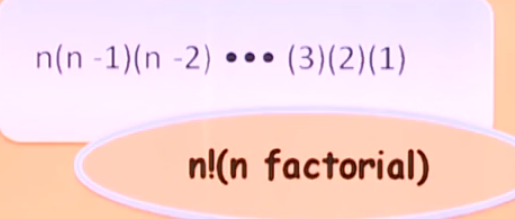
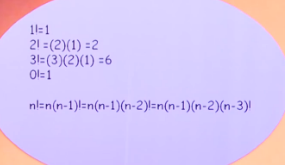
例: Suppose that 10 students are going on a bus trip, and each of the students will be assigned to one of the 10 available seats. Then the number of possible different seating arrangements of the students on the bus is
10!=(10) (9) (8) (7) (6) (5) (4) (3) (2) (1)=3,628,800
More generally, suppose that K objects will be selected from a set of n objects, and the k objects will be placed in order from 1st to kth. Then there are, n choices for the first object, n-1 choices for the second object, n-2 choices for the third object, and so on, until there are n-k+1 choices for kth object. Thus, applying the multiplication principle, the number of ways to select and order k objects from a set of n objects is n(n-1)(n-1-2)(n-1-2-3)…(n-k+1)
n(n-1)(n-1-2)(n-1-2-3)…(n-k+1)= n(n-1)(n-1-2)(n-1-2-3)…(n-k+1)(n-k)!/ (n-k)!=n!/ (n-k)!

例:How many different five-digit positive integers can be formed using the digits 1, 2, 3, 4, 5, 6, and 7 if none of the digits can occur more than once in the integer?
7*6*5*4*3=2520
7!/ (7-5)! =2520
Combinations
More generally, suppose that k objects will be selected from a set of n objects, where k n but that the k objects will not be put in order.
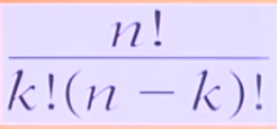
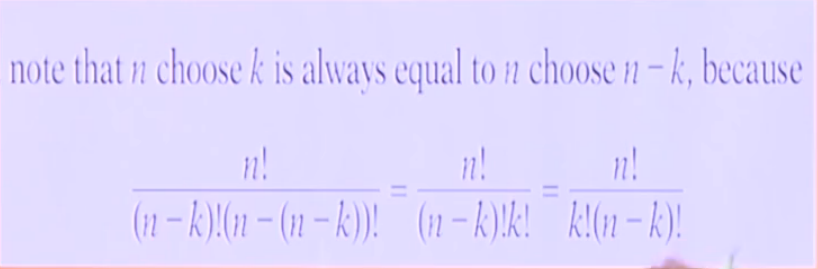
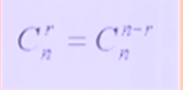
Another way to refer to the number of combinations of n objects taken k at a time is n choose k, and two notations commonly used to denote this number are
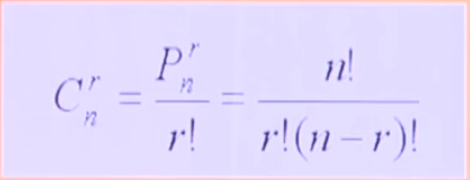
例:
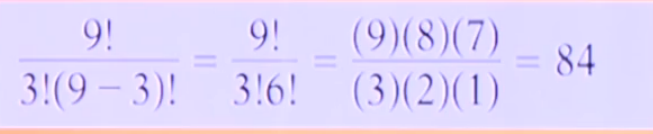
Suppose you want to select a 3-person committee from a group of 9 students. How many ways are there to do this?
例:
Consider the following experiment. A box contains 15 pieces of paper, each of which has the name of one of the 15 students in a class consisting of 7 male and 8 female students, all with different names. The instructor will shake the boa for a while and then, without looking, choose a piece of paper at random and read the name.
1. The probability that any one particular name is selected is————
2. The student selected is male, the probability is————
答案:1. 1/15 2. 7/15
概率特性:
If an event E is certain to occur, then P(E)=1.
If an event E is certain not to occur, then P(E)=0.
If an event E is possible but not certain to occur, then 0
The probability that an event E will not occur is equal to 1- P(E).
The sum of the probabilities of all possible outcomes of an experiment is 1.
If E and F are two events of an experiment, we consider two other events related to E and F.
The event that both E and F occur; that is, outcomes in the set
The event that E or F or both occur; that is, outcomes in the set
For events E and F, we have the following rules.
P (either E or F or both occur)=P(E)+P(F)-P(both E and F occur)
If E and F are mutually exclusive, then and P(both E and F occur)=0, therefore, P(either E or F or both occur)=P(E)+P(F).
If two events E and F are independent, then P (both E and F occur)=P(E)*P(F)
For ,example, if a fair 6-sided die is rolled twice, the event E of rolling a 3 on the first roll and the event F of rolling a 3 on the second roll are independent, and the probability of rolling a 3 on both rolls is ————
答案:1/36
以上就是小编为大家分享的GRE数学数据分析视频讲解的内容,希望考生能够认真巩固。
您还可能关注:


