

READING PASSAGE 1
You should spend about 20 minutes on Questions 1 – 13 which are based on Reading Passage 1 below.
It is safe to say that almost anyone can double his speed of reading while maintaining equal or even higher comprehension. In other words, anyone can improve the speed with which he gets what he wants from his reading.
The average college student reads between 250 and 350 words per minute on fiction and non-technical materials. A "good" reading speed is around 500 to 700 words per minute, but some people can read a thousand words per minute or even faster on these materials. What makes the difference? There are three main factors involved in improving reading speed: (1) the desire to improve, (2) the willingness to try new techniques and (3) the motivation to practice.
Learning to read rapidly and well presupposes that you have the necessary vocabulary and comprehension skills. When you have advanced on the reading comprehension materials to a level at which you can understand college-level materials, you will be ready to begin speed reading practice in earnest.
Understanding the role of speed in the reading process is essential. Research has shown a close relation between speed and understanding. For example, in checking progress charts of thousands of individuals taking reading training, it has been found in most cases that an increase in rate has been paralleled by an increase in comprehension, and that where rate has gone down, comprehension has also decreased. Most adults are able to increase their rate of reading considerably and rather quickly without lowering comprehension.
Some of the facts which reduce reading rate:
(a) limited perceptual span i.e., word-by-word reading;
(b) slow perceptual reaction time, i.e., slowness of recognition and response to the material;
(c) vocalization, including the need to vocalize in order to achieve comprehension;
(d) faulty eye movements, including inaccuracy in placement of the page, in return sweep, in rhythm and regularity of movement, etc.;
(e) regression, both habitual and as associated with habits of concentration
(f) lack of practice in reading, due simply to the fact that the person has read very little and has limited reading interests so that very little reading is practiced in the daily or weekly schedule.
Since these conditions act also to reduce comprehension increasing the reading rate through eliminating them is likely to result in increased comprehension as well. This is an entirely different matter from simply speeding up the rate of reading without reference to the conditions responsible for the slow rate. In fact, simply speeding the rate especially through forced acceleration, may actually result, and often does, in making the real reading problem more severe. In addition, forced acceleration may even destroy confidence in ability to read. The obvious solution, then is to increase rate as a part of a total improvement of the whole reading process.
A well planned program prepares for maximum increase in rate by establishing the necessary conditions. Three basic conditions include:
Eliminate the habit of pronouncing words as you read. If you sound out words in your throat or whisper them, you can read slightly only as fast as you can read aloud. You should be able to read most materials at least two or three times faster silently than orally.
Avoid regressing (rereading). The average student reading at 250 words per minute regresses or rereads about 20 times per page. Rereading words and phrases is a habit which will slow your reading speed down to a snail's pace. Furthermore, the slowest reader usually regresses most frequently. Because he reads slowly, his mind has time to wander and his rereading reflects both his inability to concentrate and his lack of confidence in his comprehension skills.
Develop a wider eye-span. This will help you read more than one word at a glance. Since written material is less meaningful if read word by word, this will help you learn to read by phrases or thought units.
Poor results are inevitable if the reader attempts to use the same rate indiscriminately for all types of material and for all reading purposes. He must learn to adjust his rate to his purpose in reading and to the difficulty of the material he is reading. This ranges from a maximum rate on easy, familiar, interesting material or in reading to gather information on a particular point, to minimal rate on material which is unfamiliar in content and language structure or which must be thoroughly digested. The effective reader adjusts his rate; the ineffective reader uses the same rate for all types of material.
Rate adjustment may be overall adjustment to the article as a whole, or internal adjustment within the article. Overall adjustment establishes the basic rate at which the total article is read; internal adjustment involves the necessary variations in rate for each varied part of the material. As an analogy, you plan to take a 100-mile mountain trip. Since this will be a relatively hard drive with hills, curves, and a mountain pass, you decide to take three hours for the total trip, averaging about 35 miles an hour. This is your overall rate adjustment. However, in actual driving you may slow down to no more than 15 miles per hour on some curves and hills, while speeding up to 50 miles per hour or more on relatively straight and level sections. This is your internal rate adjustment. There is no set rate, therefore, which the good reader follows inflexibly in reading a particular selection, even though he has set himself an overall rate for the total job.
In keeping your reading attack flexible, adjust your rate sensitivity from article to article. It is equally important to adjust your rate within a given article. Practice these techniques until a flexible reading rate becomes second nature to you.
Questions 1 - 4
Choose the appropriate letters A – D and write them in boxes 1 – 4 on your answer sheet.
1. Which of the following is not a factor in improving your reading speed?
(A). willing to try new skills
(B). motivation to improve
(C). desire to practice
(D). hesitate to try new techniques
2. Understanding college level materials is a prerequisite for
(A). learning to comprehend rapidly.
(B). having the necessary vocabulary.
(C). beginning speed reading.
(D). practicing comprehension skills.
3. For most people
(A). a decrease in comprehension leads to a decrease in rate.
(B). a decrease in rate leads to a increase in comprehension.
(C). an increase in rate leads to an increase in comprehension.
(D). an increase in rate leads to a decrease in comprehension.
4. Speeding up your reading rate through forced acceleration often results in
(A). reducing comprehension.
(B). increasing comprehension.
(C). increasing your reading problem.
(D). reducing your reading problem.
Questions 5 – 9
Complete the table below. Choose NO MORE THAN THREE WORDS from the passage for each answer.
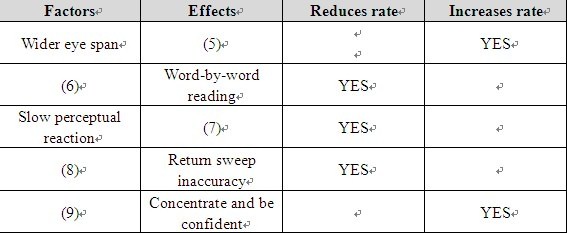
Questions 10 - 13
Do the following statements agree with the information given in Reading Passage 1? In boxes 10 – 13 on your answer sheet write.
TRUE FALSE NOT GIVEN
10. In gathering material on a topic a reader must maximize his reading rate.
11. The basic rate for each part of the reading material involves an overall adjustment.
12. The set rate for a 100-mile mountain trip is 35 miles an hour.
13. A good reader never establishes a set rate for reading an article.
KEYS
Reading passage 1, Questions 1 - 13
1. D
2. C
3. C
4. C
5. Reading phrases/Read by phrases
6. Limited perceptual span
7. Slowness of recognition
8. Faulty eye movements
9. Avoid regressing
10. TRUE
11. FALSE
12. FALSE
13. TRUE


