

SAT改革后阅读中强调了一种阅读类型为历史/社会研究类文章,因此这里小编选取官方提供的一篇sat2016改革阅读样题分析为大家进行例题详解,这篇文章整体属于较低难度。
Questions 1-3 are based on the following passage and supplementary material.
This passage is adapted from Richard Florida, The Great Reset. ©2010 by
Richard Florida.
In today’s idea-driven economy, the cost of time is what
really matters. With the constant pressure to innovate, it
makes little sense to waste countless collective hours
commuting. So, the most efficient and productive regions are
Line 5 those in which people are thinking and working—not sitting
in traffic.
The auto-dependent transportation system has reached its
limit in most major cities and megaregions. Commuting by
car is among the least efficient of all our activities—not to
10 mention among the least enjoyable, according to detailed
research by the Nobel Prize–winning economist Daniel
Kahneman and his colleagues. Though one might think that
the economic crisis beginning in 2007 would have reduced
traffic (high unemployment means fewer workers traveling to
15 and from work), the opposite has been true. Average
commutes have lengthened, and congestion has gotten worse,
if anything. The average commute rose in 2008 to
25.5 minutes, “erasing years of decreases to stand at the level
of 2000, as people had to leave home earlier in the morning to
20 pick up friends for their ride to work or to catch a bus or
subway train,” according to the U.S. Census Bureau, which
collects the figures. And those are average figures. Commutes
are far longer in the big West Coast cities of Los Angeles and
San Francisco and the East Coast cities of New York,
25 Philadelphia, Baltimore, and Washington, D.C. In many of
these cities, gridlock has become the norm, not just at rush
hour but all day, every day.
The costs are astounding. In Los Angeles, congestion eats
up more than 485 million working hours a year; that’s seventy
30 hours, or nearly two weeks, of full-time work per commuter.
In D.C., the time cost of congestion is sixty-two hours per
worker per year. In New York it’s forty-four hours. Average it
out, and the time cost across America’s thirteen biggest city
regions is fifty-one hours per worker per year. Across the
35 country, commuting wastes 4.2 billion hours of work time
annually—nearly a full workweek for every commuter. The
overall cost to the U.S. economy is nearly $90 billion when lost
productivity and wasted fuel are taken into account. At the
Martin Prosperity Institute, we calculate that every minute
40 shaved off America’s commuting time is worth $19.5 billion in
value added to the economy. The numbers add up fast: five
minutes is worth $97.7 billion; ten minutes, $195 billion;
fifteen minutes, $292 billion.
It’s ironic that so many people still believe the main
45 remedy for traffic congestion is to build more roads and
highways, which of course only makes the problem worse.
New roads generate higher levels of “induced traffic,” that is,
new roads just invite drivers to drive more and lure people
who take mass transit back to their cars. Eventually, we end up
50 with more clogged roads rather than a long-term
improvement in traffic flow.
The coming decades will likely see more intense clustering
of jobs, innovation, and productivity in a smaller number of
bigger cities and city-regions. Some regions could end up
55 bloated beyond the capacity of their infrastructure, while
others struggle, their promise stymied by inadequate human
or other resources.
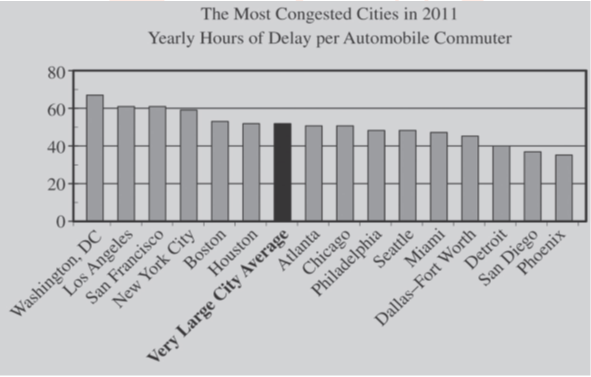
Adapted from Adam Werbach, “The American Commuter Spends 38 Hours a Year Stuck in Traffic.” ©2013 by The Atlantic.
1. The passage most strongly suggests that researchers at the Martin Prosperity Institute share which assumption?
(A) Employees who work from home are more valuable to their employers than employees who commute.
(B) Employees whose commutes are shortened will use the time saved to do additional productive work for their employers.
(C) Employees can conduct business activities, such as composing memos or joining conference calls, while commuting.
(D) Employees who have longer commutes tend to make more money than employees who have shorter commutes.
题目考点:Rhetoric –修辞
答案:B
答题思路:考生必须从文章的隐含意义中进行合理的推测
解析:选B的原因是文章第三段的28-43行中指出研究者们(也就是我们)在Martin
Prosperity Institute上猜测更短的上下班往返时间会提供更多的工作时间。作者提到“across the country, commuting wastes 4.2 billion hours of work time annually” and that “the overall cost to the U.S. economy is nearly $90 billion when lost productivity and wasted fuel are taken into account” (lines 34-38).在加上那些在协会上的人“calculate that every minute shaved off America’s commuting timeis worth $19.5 billion in value added to the economy” (lines 39-41),因此从这些话中可以推断出某些额外的价值是来自员工的高效工作。
2. As used in line 52, “intense” most nearly means
(A) Emotional
(B) concentrated
(C) brilliant
(D) determined
题目考点:Information and Ideas 信息观点题
答案:B
答题思路:考生需根据文章内容选出词汇最准确的意思
解析:原句的意思是说在未来的几十年里,大量工作,创新以及生产都会涌现在较大城市和城市区域中。从后面的一句Some regions could end up bloated beyond the capacity of their infrastructure, while others struggle, their promise stymied by inadequate human or other resources.也可以看出城市发展会进入急剧膨胀的阶段,因此结合上下文可以看出这里“intense”的意思是想表现出”聚集,汇聚”的意思,也就是选项B中的“concentrated”
3. Which claim about traffic congestion is supported by the graph?
(A) New York City commuters spend less time annually delayed by traffic congestion than the average for very large cities.
(B) Los Angeles commuters are delayed more hours annually by traffic congestion than are commuters in Washington, D.C.
(C) Commuters in Washington, D.C., face greater delays annually due to traffic congestion than do commuters in New York City.
(D) Commuters in Detroit spend more time delayed annually by traffic congestion than do commuters in Houston, Atlanta, and Chicago.
Objective: Students must interpret data presented graphically.
题目考点:Synthesis 综合问题
答案:C
答题思路:考生需从给出的图表中分析数据
解析:图表中较高的柱形条表示每年较长的上下班往返时间,因此图表上从左到右表示的是2011年城市拥堵时间依次递减,所以C选项中华盛顿表示的柱形条比纽约表示的柱形条要高,也就是花费的时间长,所以是正确的。
选项A:纽约和大城市平均值相比,柱形条更高,所以花费的时间是更多而不是更少。
选项B:洛杉矶和华盛顿的城市交通拥堵时间相比,华盛顿的柱形条更高,因此华盛顿花费的时间更多。
选项D:底特律和休斯顿,亚特兰大,芝加哥相比,底特律的柱形条最低,所以交通拥堵的时间最短。
以上就是小编针对SAT阅读改革中的一篇样题分析,希望对备考新SAT考试的考生们有帮助,找到这类文章的做题方法和技巧。
您还可能关注:

前程百利SAT官方QQ:390352172


